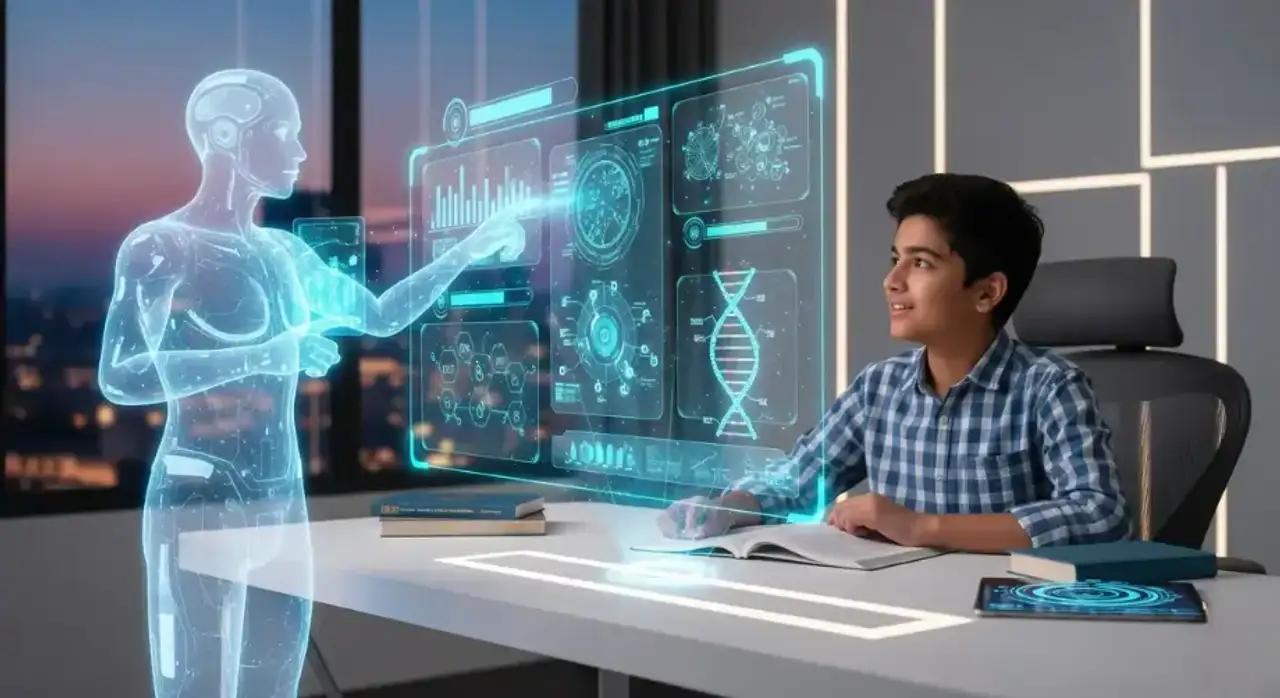
In March 2026, a rigorous study conducted across 127 schools in Singapore, Finland, and the United States delivered results that educators can no longer ignore: students using AI tutoring systems demonstrated learning gains that exceeded traditional classroom instruction by an average of 34%. More strikingly, students in the bottom quartile—those traditionally labeled as 'struggling learners'—showed improvements of 58% when given access to personalized AI tutoring compared to standard instruction. Education technology has finally delivered on its decades-old promise of personalized learning at scale.
What Makes AI Tutoring Different
The current generation of AI tutors, led by platforms like Khan Academy's Khanmigo, Carnegie Learning's MATia, and Google's LearnLM, represent a fundamental leap beyond previous edtech. These aren't glorified flashcard apps or video libraries—they're adaptive systems that understand individual learning patterns, identify knowledge gaps with precision, and adjust teaching strategies in real-time based on student responses.
A student struggling with algebra might have trouble not because they don't understand equations, but because they have gaps in underlying fraction concepts from two years ago. AI tutors identify these root causes by analyzing patterns across hundreds of problem attempts, then dynamically construct personalized learning paths that address foundational gaps before returning to the current material.
The systems also adapt their teaching style to individual learners. Visual learners receive more diagrams and spatial representations. Students who respond well to Socratic questioning get more guided discovery. Those who need direct instruction receive clear, step-by-step explanations. This level of individualization is impossible for a human teacher managing 30 students simultaneously.
The Singapore Deployment
Singapore's Ministry of Education rolled out AI tutoring across its entire secondary school system in September 2025, making it the first country to deploy AI-assisted learning at national scale. The results from the first two academic terms are striking: mathematics proficiency increased by 23% among previously struggling students, time-to-mastery for core concepts decreased by 31% on average, student engagement metrics (time on task, voluntary practice) increased significantly, and teacher-reported student confidence improved across all ability levels.
Perhaps most importantly, teacher satisfaction increased rather than decreased. When teachers were freed from repetitive explanation of basic concepts—the AI handles that—they could focus on higher-order skills, collaborative projects, and individual mentorship. Teachers describe their role shifting from 'sage on the stage' to 'guide on the side,' with AI handling personalized skill-building while humans focus on critical thinking, creativity, and social-emotional development.
The Equity Implications
AI tutoring has the potential to address one of education's most persistent challenges: the achievement gap between wealthy and poor students. Wealthy families have always had access to private tutors, test prep services, and enrichment programs. AI can provide personalized tutoring at marginal cost, potentially democratizing access to high-quality individualized instruction.
Pilot programs in underserved districts in Detroit, rural Mississippi, and the South Bronx showed particularly strong results. Students who previously had no access to tutoring outside school hours could now receive unlimited personalized help via smartphone. Language learners benefited from AI that adapted explanations to their English proficiency level while teaching content simultaneously.
However, the digital divide remains a barrier. Students without reliable internet access or devices can't benefit from AI tutoring. Several US states and European countries are now treating AI tutoring access as basic educational infrastructure, funding device and connectivity programs specifically to enable AI-assisted learning.
The Teacher Displacement Question
The elephant in the room: if AI can teach more effectively than humans, do we still need teachers? The emerging consensus from educators and researchers is that we need teachers more than ever—but their role is changing fundamentally.
Skills that AI can't replicate include motivating students through personal connection and mentorship, facilitating group discussions and collaborative learning, developing social-emotional skills and character, identifying students struggling with non-academic issues, creating classroom culture and community, and teaching critical thinking about AI-generated information itself.
The jobs at risk aren't classroom teachers but tutoring and test-prep industries. Why pay $100/hour for human SAT tutoring when AI can provide equivalent or better instruction for $20/month? The $15 billion private tutoring industry is facing an existential disruption.
Concerns and Limitations
AI tutoring isn't without problems. Some students become over-reliant on AI assistance and don't develop independent problem-solving skills. AI systems can propagate biases present in training data, potentially reinforcing educational inequities. Student data privacy concerns are significant—detailed records of every learning interaction create surveillance risks. And there's the broader question of whether education optimized for measurable outcomes neglects harder-to-quantify goals like creativity, curiosity, and love of learning.
Several schools have reported students using AI tutors to complete homework without actually learning—the system provides step-by-step help that students copy without understanding. Educators are responding by shifting assessment away from homework completion toward in-class demonstration of skills.
The Future of Learning
Five years from now, it's likely that AI tutoring will be as standard in education as textbooks are today. The schools and districts embracing this transition now—figuring out how to integrate AI effectively while preserving the irreplaceable human elements of teaching—will be positioned to deliver dramatically better outcomes. Those that resist the change risk falling further behind as the performance gap between AI-assisted and traditional education continues to widen.
Education has been remarkably resistant to technology-driven transformation for decades. AI might finally be the force that succeeds in reshaping how humans learn.